
.webp)
Grounded in 20+ years of Fortune 500 advisory work and Glenn's Leadership in the Age of Personalization (LAOP) Methodology. 8 independent research sources. 500,000+ data points.
Contact GlennYears Advisory Work
Keynote Topics
Annual Disengagement Cost
Research Data Points
The Manager Crisis: Why the Middle of Your Organization Is Failing Everyone
Human Leadership in the AI Era: What Machines Cannot Do, and You Must
The Quality Job Crisis: How Standardized Leadership Is Costing You Your Best People
Reinvention Readiness: Why 79% of Leaders Are Not Prepared, and How to Close the Gap
The Mental Health Crisis Is a Leadership Crisis: What Personalized Leadership Actually Prevents
The Sponsorship Imperative: The Highest-Leverage Leadership Investment You're Underusing
.png)
Manager engagement has collapsed from 30% to 27%, and managers account for 70% of all team engagement variance. This keynote names the structural cause: managers are being squeezed between executive expectations and employee realities without the tools to lead adaptively. They are navigating post-pandemic restructuring, AI transformation, hiring volatility, and new employee demands, all at once, without a framework designed for this complexity. The result is precisely what the Leadership in the Age of Personalization (LAOP) methodology has diagnosed for two decades: systems that were never designed to treat people as individuals.
Manager engagement has collapsed from 30% to 27%, and managers account for 70% of all team engagement variance. This keynote names the structural cause: managers are being squeezed between executive expectations and employee realities without the tools to lead adaptively. They are navigating post-pandemic restructuring, AI transformation, hiring volatility, and new employee demands, all at once, without a framework designed for this complexity. The result is precisely what the Leadership in the Age of Personalization (LAOP) methodology has diagnosed for two decades: systems that were never designed to treat people as individuals.

AI has the highest applicability to knowledge work, the very roles most represented in leadership pipelines. Microsoft's analysis of 200,000 Copilot conversations documents exactly what AI assists with: information gathering, writing, advising, explaining. But the research is equally clear about what AI cannot replicate: strategic vision under uncertainty, trust-building, cultural intelligence, psychological safety, authentic purpose-setting, and mentorship. The Leadership in the Age of Personalization (LAOP) framework builds every one of them.
C-suite and senior executives navigating AI transformation; technology and innovation leaders; HR and talent professionals developing AI-era leadership pipelines; boards and executive committees evaluating organizational readiness for AI-driven disruption.
60% of U.S. workers are not in quality jobs. The demographic disparities are stark: only 28% of Black workers and 32% of Hispanic workers are in quality jobs, compared to 42% of White workers. Youth (18-24) clock in at 29%, the lowest of any age group. These are not HR metrics. They are leadership accountability data. This keynote reframes inclusion from a values conversation into a performance and risk management conversation and delivers the LAOP 5 Shifts as the structural architecture for closing every gap the data documents.
CHROs, Chief Diversity Officers, and DEI leaders seeking frameworks that connect inclusion to business outcomes; CEOs and COOs facing talent retention and workforce performance challenges; any organization under pressure to demonstrate measurable inclusion ROI.
79% of leaders admit they are not reinvention-ready. Not because they lack strategy, but because they cannot sustain transformation against organizational inertia. Meanwhile, 73% of workers feel unprepared to adapt in the next five years, and 87% of Gen Z workers feel unprepared to succeed at work today. This keynote translates the LAOP reinvention cycle (Learn, Unlearn, Relearn, Repeat) into a generational readiness strategy that speaks to every cohort in the room differently.
Senior executives and leadership teams navigating major organizational transformation; CHROs and talent leaders building future-ready development programs; any cross-generational leadership audience facing disruption, restructuring, or AI-driven role redefinition.
Mental health leaves are up 65% since 2021. The severity of conditions has increased 46%. Managers are simultaneously the most psychologically burdened demographic in any organization and the primary gateway for employee mental health support, yet 96% of organizations agree managers need more training than they currently receive. Most organizations respond with wellness programs. This keynote argues, backed by research, that personalized leadership is the structural upstream intervention.
Chief People Officers and benefits leaders evaluating mental health strategy; executive teams seeking to address burnout; healthcare organization leaders; any senior leader who has watched mental health leaves increase and wants to address root cause, not symptoms.
C-suite leaders rank personalized sponsorship and advocacy as the highest-impact investment in leadership pipelines. 83% say it is the most impactful development activity available. Yet only 68% of companies actually practice it consistently. This 15-point gap represents the single most cost-effective, underutilized leadership development opportunity in most organizations.
C-suite executives responsible for succession planning and leadership pipeline development; CHROs and talent development leaders building sponsorship programs; diversity and inclusion leaders seeking to connect equity strategy to business performance.
.webp)
Of all five LAOP Shifts, the move from Tribal to Human is the most urgent in 2026. Tribal leadership puts people into the boxes they check, dividing departments, identities, and stories in ways that make organizations less collaborative, less innovative, and less human. The AJQS data showing 55% of employees feeling a voice gap, and demographic job quality disparities that reach 14 percentage points between racial groups, are a direct empirical indictment of tribal leadership operating at scale.
Senior leadership teams experiencing cross-functional dysfunction, silo breakdowns, or cultural fragmentation; organizations where diversity hiring has not translated into inclusion outcomes; any audience where the gap between stated inclusion values and lived organizational culture is visible.
The 4 Skills (See, Sow, Grow, and Share) were built from Glenn's Cuban American immigrant experience of learning to find opportunity where others saw scarcity. They are now the answer to the most pressing question the AI era has produced: what do human leaders actually do once AI handles the routine work? The 4 Skills are the meta-capabilities that make AI-assisted work produce breakthrough outcomes rather than incremental efficiency.
Entrepreneurial leaders and innovation teams inside large organizations; executives building next-generation leadership pipelines; organizations deploying AI tools and seeking to maximize human value-add; any leadership audience navigating uncertainty, disruption, or major strategic transition.
The Shift from Results to Methods is the Leadership in the Age of Personalization (LAOP) message most transformed in relevance by the AI era. Microsoft's Frontier Firms, organizations achieving measurable AI ROI, are not defined by their technology investment. They are defined by environments where people are trusted to work adaptively, where psychological safety enables experimentation, and where process is valued alongside output.
Executives leading digital transformation and AI integration initiatives; innovation leaders and product organization heads; CHROs building cultures of experimentation and psychological safety; operations leaders seeking to move from compliance cultures to adaptive performance cultures.
Of the 6 Strategies for the Innovation Mentality, 'Lead to Leave a Legacy' has been elevated by the AI era from inspirational framing to existential leadership strategy. Microsoft's AI occupational research documents with precision which leadership activities AI can perform and which remain irreducibly human. Mentorship, sponsorship, authentic purpose-setting, psychological safety creation, and ethical navigation of complex decisions. These are the activities that define legacy leadership, and they are precisely what AI cannot replicate.
Senior executives in the second half of their careers making decisions about how to spend their remaining organizational capital; boards and executive committees thinking about succession and institutional legacy; CHROs building cultures of mentorship and knowledge transfer.
The Leadership in the Age of Personalization (LAOP) Personal Brand framework asks four questions: What is your Enduring Idea? What is your Primary Differentiator? What is your Primary Experience? What do you Solve For? These questions are the self-awareness architecture that connects individual development to organizational purpose, and the research has now built the empirical case for why they are urgently needed at scale.
Mid-career and senior leaders seeking to reconnect with their authentic leadership identity; talent development professionals; emerging leaders building their professional identity; any audience navigating career transition, organizational change, or identity uncertainty.
.png)


.png)
.png)
.png)
The Leadership in the Age of Personalization (LAOP) framework answers: what does leadership need to become? Earning Conviction answers the equally critical question the research now demands: what does a leader need to be, internally, to sustain that transformation against the organizational forces that continuously pull them back to standardization? Transformation fails not because strategies are wrong, but because leaders cannot sustain them. Conviction is earned through practice, not granted, not trained, not transferred.
Exhausted senior executives who have achieved success but lost their conviction, identity, or joy in leadership; any leadership audience experiencing the knowing-doing gap; organizations where transformation initiatives consistently stall; executive retreat settings where honest, high-stakes leadership conversations are expected.
Hispanic Leadership Cultural Demographic Shift™ Post-DEI
Something is breaking in American institutions. Leaders feel it in the boardroom. Parents feel it at the dinner table. Faculty feel it in the classroom. A friction that no existing framework, not culture war, not generational divide, not diversity crisis, not political polarization, has been able to name, let alone resolve.
Glenn's thesis is precise: a world built on standardization and assimilation is colliding across five simultaneous generations with a wave of people who have decided they will not disappear into the framework anymore.
Something is breaking in American institutions. A friction that no existing framework, not culture war, not generational divide, not diversity crisis, has been able to name, let alone resolve. Glenn's thesis is precise.
Something is breaking in American institutions. Leaders feel it in the boardroom. Parents feel it at the dinner table. Faculty feel it in the classroom. A friction that no existing framework, not culture war, not generational divide, not diversity crisis, not political polarization, has been able to name, let alone resolve.
Glenn's thesis is precise: a world built on standardization and assimilation is colliding across five simultaneous generations with a wave of people who have decided they will not disappear into the framework anymore.
The community the system spent twenty years asking to make itself smaller was carrying the exact operating system the age of personalization requires of every leader. The community was always the solution. It was being treated as the problem.
For Hispanic audiences including ALPFA, NAHREP, CHCI, HACR, Hispanic ERGs, and community convenings, this keynote names what they have always carried as leadership, not culture. For non-Hispanic corporate and institutional leadership audiences, including C-suite executives, board members, university presidents, and healthcare system leaders, this is the strategic argument for why the resolution of institutional tensions runs directly through the community they have spent twenty years asking to assimilate.
.png)
Llopis' keynote tells it like it is: businesses are creating opportunity gaps rather than seizing the right opportunities for growth. His keynote not only tells us why but also shows how the workplace and marketplace must embrace the courage diversity of thought brings to rebuild an organization and leaders' mindset to seize previously unseen strategies for growth.
.png)
Glenn's keynote hits all the right notes when it comes to business growth. What makes Llopis' six strategies different is they are profoundly human. Leaders must have the courage to seize the demographic shift and make innovative thinking a core competency. Llopis clearly explains why diversity of thought is a strategic imperative to building the future.
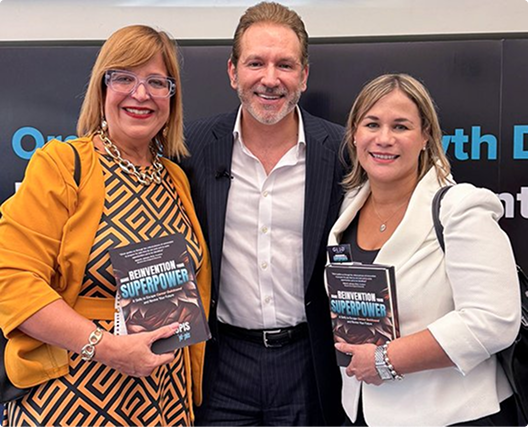
Glenn Llopis (pronounced YO-pēs) is a Cuban American executive, entrepreneur, and senior advisor to Fortune 500 companies in retail, consumer packaged goods, healthcare, and beyond. Bestselling author of six books: Earning Serendipity, The Innovation Mentality, Leadership in the Age of Personalization, Unleashing Individuality, Make Reinvention Your Superpower, and Earning Conviction. Founder of the Leadership in the Age of Personalization (LAOP) movement and The Conviction Institute. Forbes leadership contributor since 2010. Recognized as a top 100 leadership speaker by Inc. magazine.

.webp)